
Shipbuilding at Harvey’s of Hayle
By Tony Clifford
Although best known for the production of mining machinery, Harvey & Co. were also heavily involved in the shipbuilding trade. The company’s shipbuilding activities formed a significant part of Hayle’s industrial heritage until the shipyard closed in 1904.
Harvey’s extensive shipyards, slips and docks, developed during the 19th century, were located at South Quay and Carnsew. They are integral to understanding Hayle’s development into a major industrial port and an internationally renowned centre for the production of steam pumping engines.
Shipbuilding on a large scale began in 1834, following the reconstruction of South Quay and the creation of a full-scale shipyard. Initially, the company built small wooden lighters and coasting schooners, but the shipyard subsequently expanded to become one of the principal elements of its business.
For many years, Harvey’s continued to purchase sailing vessels to transport coal, iron and other goods for the foundry. One of the earliest was the sloop Providence, built at Barmouth in 1777 and acquired by John Harvey in 1787.
A small sloop, Elizabeth, was the first vessel built at Hayle in 1805. She was wrecked at or near Morwenstow in 1820. Following her loss, Henry Harvey commissioned a replacement, the schooner John Adams, built at Neath in 1820. Unfortunately, she was lost with all hands in December 1823.
Another schooner called Elizabeth was built at Hayle in 1836, the same year as the schooner Carnsew, specially designed to carry boilers. On 17 October 1879, Carnsew, while on a voyage from Caithness to Greenock carrying 120 tons of stone, sprang a leak and sank off Whiting Bay, Arran.
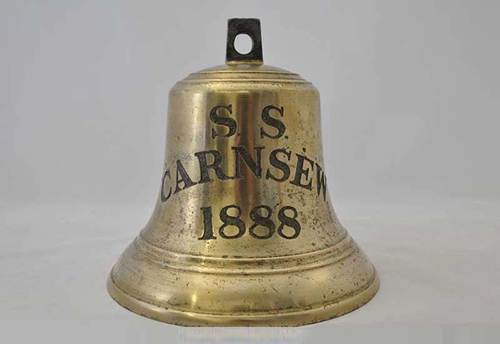
A second steam coaster called Carnsew was built by Harvey’s in 1888. She was used to transport coal, tin and copper ore between ports in Cornwall and South Wales, via Bristol. In October 1903, she sank following a collision with SS Everest off Bull Point, North Devon, while travelling from Newport to Hayle with a cargo of coal. Fortunately, no lives were lost. Her bell was recovered by divers in 2014 and is now on display at Hayle Heritage Centre.
As Harvey’s prospered, its shipping enterprise continued to expand. Between 1834 and 1844, a further thirty sailing ships were built, ranging from schooners to smacks. The company also began constructing larger iron vessels. The plating and riveting were ideally suited to the skills of its experienced boilermakers, while shipwrights in many other ports around the coast continued to concentrate on traditional wooden construction.
Early steam coasters owned in South Wales, Bristol and Liverpool regularly called at Cornish mineral ports, delivering South Wales coal and loading copper and tin ore. One of the earliest examples of a Cornish company owning such a vessel dates from 1867, when Harvey’s of Hayle built the Hayle for its own use. She was probably employed in transporting coal from Newport and made occasional visits to her home port.
In 1888, the shipbuilding yard was equipped with new slipways, boiler works and machine shops, intended to help it compete nationally with other shipyards. Between 1831 and 1893, 79 timber, iron and steel vessels were built at Harvey’s foundry and shipbuilding yard.
SS Ramleh, a steel screw steamer built by Harvey’s (shown during construction at Hayle in 1891), was the largest steel ship built in Cornwall. She measured 89.6 metres in length and had a cargo capacity of 3,800 tons. The vessel had a complex ownership history, serving various companies, including W. Wheatley & Co. and Christian Salvesen, before her final voyage. Carrying coal, bricks and steel from the Tyne to Genoa, Ramleh was lost in a collision with the Danish steamer Nordamerika on 18 September 1918, approximately 62 miles north of Ténès, Algeria.
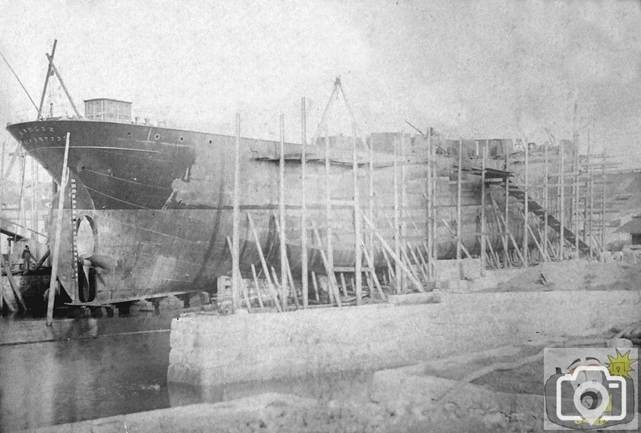
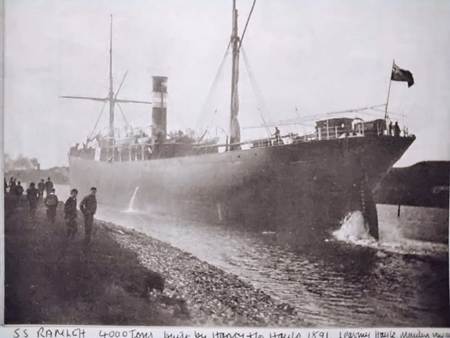
SS Ramleh leaving Hayle on her maiden voyage, 1891. Due to her size, she had to be launched sideways.
By 1831, the Harvey Steamship Company had been formed. A weekly service between Bristol and Hayle began using the wooden paddle steamer Herald, built by John Scott & Son of Greenock. A single fare for the 150-mile journey was £1 5s, and the crossing took approximately 22 hours.
Bessie was a veteran of the Bristol packet service. She ran aground at Lelant on her maiden voyage in 1866 and again in 1878, before finally meeting her end in what was certainly one of the most devastating events in the history of shipwrecks in St Ives Bay: the notorious ‘Cintra Gale’ of 1893.
A terrible north-easterly gale on 17 November 1893 resulted in the loss of three colliers, Cintra, Bessie and Vulture, on Carbis Bay beach. The photograph shows the 287-ton Hayle-built Bessie broadside to the surf on the beach, with the boilers of the 345-ton Vulture of Cardiff visible beyond.
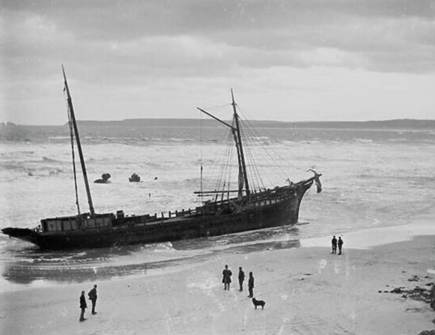
The crew of Vulture, all from St Ives and Hayle, were brought ashore by breeches buoy. Everyone aboard Bessie was also safely rescued. Today, the skeletal remains of these vessels can sometimes be seen following severe storms or exceptionally low tides.
The worst casualty of the gale, however, was the Hampshire of Glasgow, which sank approximately ten miles north of Godrevy, with the loss of fifteen men.
Once the Hayle-to-Bristol services ceased, Harvey’s steamers were dedicated to coal carrying. The company had the distinction of being one of Cornwall’s longest-established native shipowners, operating a small fleet in the coastal bulk trades until 1933.
The success and reputation of Harvey’s resulted in some lucrative and prestigious contracts. One of its earliest outside commissions came in 1846 with the construction of steam-driven iron tugs, including the Prussian Eagle, the first iron and wood vessel built in the shipyard, for use on the River Rhine.
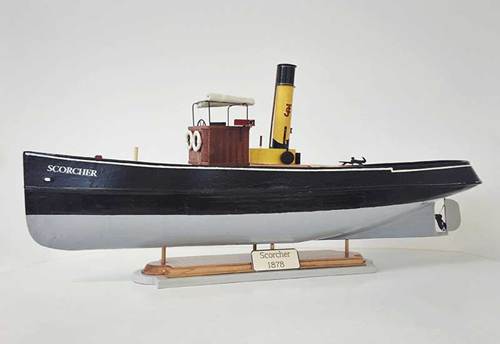
(Model by John Anthony Model Design, Scarborough, at Hayle Heritage Centre.)
Scorcher was a steam tug built by Harvey’s in 1878. She enjoyed an 80-year working life, towing barges on the River Thames for Clements, Knowling & Co. of Brentford. She was broken up by T W Ward at Grays, Essex, in 1958. In 1940, Scorcher took part in Operation Dynamo, the evacuation of Dunkirk.
Cornubia, the first large paddle steamer built in Cornwall by Harvey’s, was launched in February 1858 as a packet ship and ferry for the Hayle and Bristol Steam Packet Company. She operated between Bristol and Hayle from 1858 to 1861, also calling at Ilfracombe.
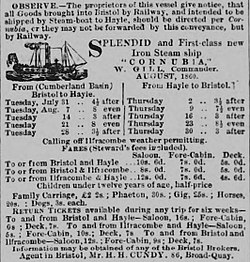
During the American Civil War, agents of the Confederacy purchased Cornubia in November 1861 and took her across the Atlantic. An excellent blockade runner, she successfully avoided or outran Union forces on 22 occasions, delivering vital supplies to the Confederate Army at Wilmington. She was eventually captured by the Union Navy in November 1863 and sold in 1865.
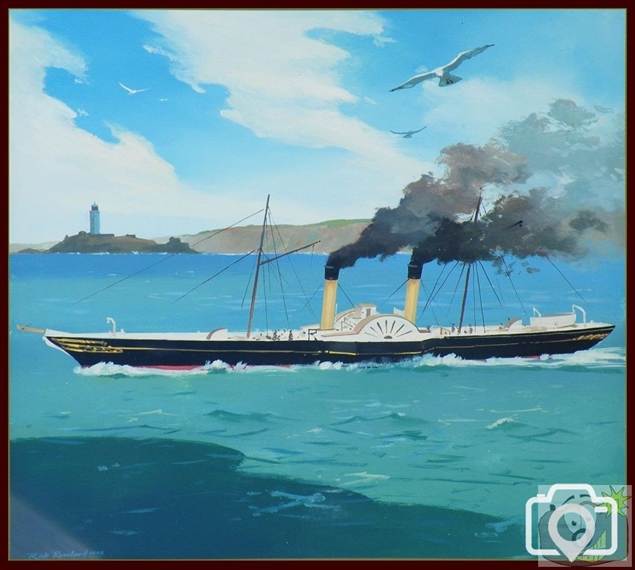
The Cornubia shown on an inn sign (1867). A sleek ship with two funnels mounted close together amidships and a high bridge over her paddle wheels, she plied the Bristol Channel before later serving both Confederate and Union interests.
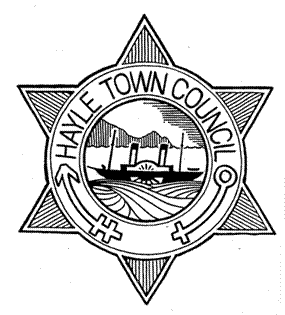
The new insignia for the Mayor of Hayle was designed and made in 1980 by Robin Kewell. It takes the shape of a six-pointed star, with each point representing one of the six manors making up the town: Riviere, Pulsack, Trevassack, Trelissick, Bodriggy and Penpol. Stylised chemical symbols for iron and copper surround a central boss depicting the SS Cornubia sailing across the bay.
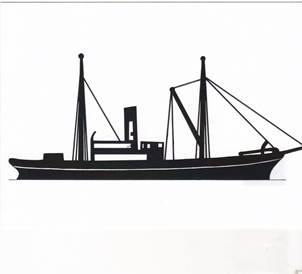
SS Lady of the Isles was built at Hayle in 1875 for the West Cornwall Steamship Company. She was launched by Miss Denbigh, daughter of the secretary of Harvey’s of Hayle, on 15 March 1875. Measuring 39.8 metres in length, she was designed to accommodate ninety passengers.
Initially, she served as a passenger, cargo and mail vessel on the Isles of Scilly route until 1905. During her career, she went to the aid of many vessels in distress, including the SS Schiller, a German ocean liner which sank after striking the Retarrier Ledges in the Isles of Scilly in May 1875, with the loss of 335 lives.
At the end of 1905, Lady of the Isles was sold to the Western Marine Salvage Company of Penzance. In 1929, she was purchased by Captain Harry Simpson of Penzance. Eventually, in 1938, she was requisitioned by the Admiralty as an auxiliary vessel.
(Photograph: Gibson’s of Scilly, G14302.)
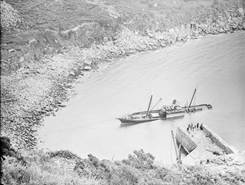
While in Royal Navy service, Lady of the Isles struck a magnetic mine and sank off Killigerran Head, near Falmouth, on 3 October 1940, with the loss of sixteen crew members. Wartime air raids on Falmouth in October 1940, together with the danger from mines, resulted in the harbour being closed. Three vessels were lost in the area: Lady of the Isles, Jersey Queen and the Dutch tug Lauwerszee.
Lyonnesse was an enlarged passenger ferry built by Harvey’s in 1889. She remained on the Isles of Scilly service until 1918, before being sold in 1919 to a salvage company in Queenstown, Ireland. She returned to Hayle in May 1928 to be broken up by T W Ward.
Her sale brought to an end the long and, at times, financially troubled history of the West Cornwall Steam Ship Co. Ltd. The gap was filled by the formation, in 1920, of the Isles of Scilly Steamship Co. Ltd, a locally owned company which continues to provide a connection to the mainland today.
PS Guide (later SS Jubilant) was a passenger vessel built by Harvey’s for the Dartmouth Steam Packet Company in 1869. She was designed as a powerful steam tug and passenger vessel for the summer excursion trade, including trips to the Channel Islands and France.
She was sold to the West Cornwall Steam Ship Company in 1872, following the loss of both its vessels, and remained in service until 1875. After being sold on several more times, Guide was presumed lost in a gale in November 1897 after disappearing while on a voyage from Maldon to the Tyne.
SS Hayle was the final ship constructed by Harvey’s. Built in 1893, she was used to transport coal from Newport, South Wales.
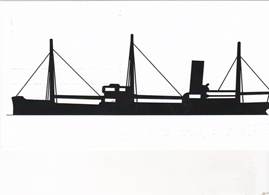
There were, however, earlier vessels bearing the same name. The brig Hayle was built at Hayle Foundry in 1835 for deep-sea trading in the Mediterranean and across the Atlantic. A brig is defined as a two-masted vessel, square-rigged on both masts, with a gaff sail as the lowest course on the mainmast.
Fitted with a figurehead depicting a man’s bust, this Hayle was also given stern galleries, with a view to carrying cabin passengers.
Another steamship, SS Hayle, was built by Harvey’s for the Tom Mawr Company of Neath in 1867 to carry coal. After spending some time laying marine cables, she passed into foreign ownership and experienced several damaging collisions. Renamed Nuevo Ampurdanés, she sank on 14 March 1918 while travelling from Cette to Barcelona, following a collision with another steamer off Mataró, Spain.
The 1870s and 1880s saw considerable activity at Harvey’s, particularly around the wharves. By 1888, approximately 1,200 people were employed, and shipbuilding had become the main activity.
Sadly, very little of any significance now survives from this final great period of expansion and activity. As mining began to decline and railway services improved, work at the foundry and on the quays gradually diminished.
Although ship repairs continued for a time, Harvey’s shipyard and engine works closed in 1903/04. The company subsequently changed direction, moving into the building trade and coal and timber supplies. The successor company, Harvey and Co. of Hayle, continued trading as a general and builders’ merchant before merging with UBM in 1969 to become UBM-Harvey.
The importance of Harvey’s to Hayle is perhaps best summed up in the following quotation:
“As a manufacturing centre for the mining industry, a smelting centre for both tin and copper, the main port of entry for coal, timber, leather, grain, iron and all the other goods needed for the mines, the major home port for the fleet that carried the goods, and the major shipbuilding centre in Cornwall, Hayle was in a very real sense the power house of Cornish industry.”
(Hayle Historical Assessment: Main Report, Cornwall Archaeological Unit, 2000.)
Although the company is now long gone, we should never underestimate the contribution made by Harvey’s, particularly its shipbuilding activities, to Hayle’s former industrial prominence.
Details of the Harvey fleet up to 1844 can be found in Appendix VI of The Harveys of Hayle by Edmund Vale (1966). Lists of ships built by Harvey’s are also available online, including through the John Harvey (ironfounder) entry on Wikiwand.
The silhouettes of ships used in this article are taken from a set of seven postcard designs by Linda King.
Tony Clifford
September 2025