
Butchers in 19th-century Hayle
Hayle in the Victorian period was a busy industrial and maritime town. Its economy was tied to the harbour, shipping, engineering, foundries, mining and the surrounding agricultural countryside. That created a substantial local market for meat and other provisions.
The surviving 1881 census material shows that commercial premises in Hayle included butcher’s shops. In one section of Commercial Road, the census transcript actually records a premises simply as a “Butcher’s shop.”
By 1891 we can identify one butcher family quite clearly: Thomas Polkinghorne, aged 39, was recorded as a butcher in Commercial Road, with his 22-year-old son John also working as a butcher. This gives us a good picture of the trade as a family occupation, with sons entering the business.
At 42 Penpol Terrace, there is a surviving Grade II listed building now known as Carnsew Gallery. Historic England identifies it specifically as:
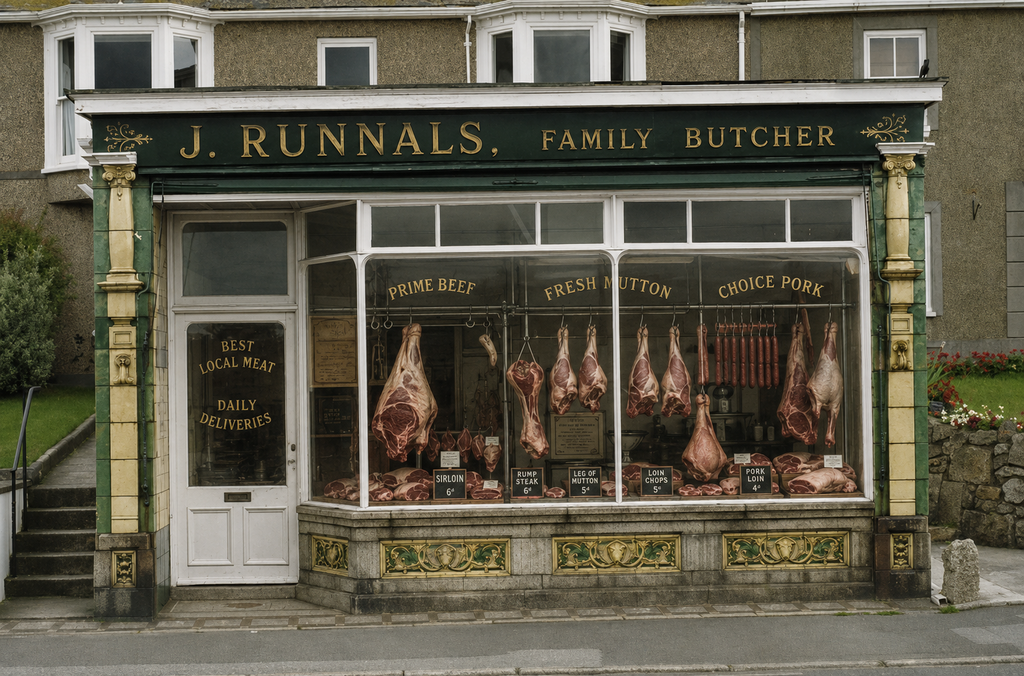
the former butcher’s shop of John Runnals
The building dates to 1893 and was designed by Sampson Hill of Redruth.
This is a remarkable little building. It retains much of its original shopfront, including:
- glazed tiles
- terracotta decoration
- original plate-glass windows
- a tiled mural depicting a bull
- decorative sheep’s heads
- the original butcher’s fittings, including hanging hooks
The building was constructed as a front-garden shop, a characteristic feature of Penpol Terrace.
The date on your statement is important
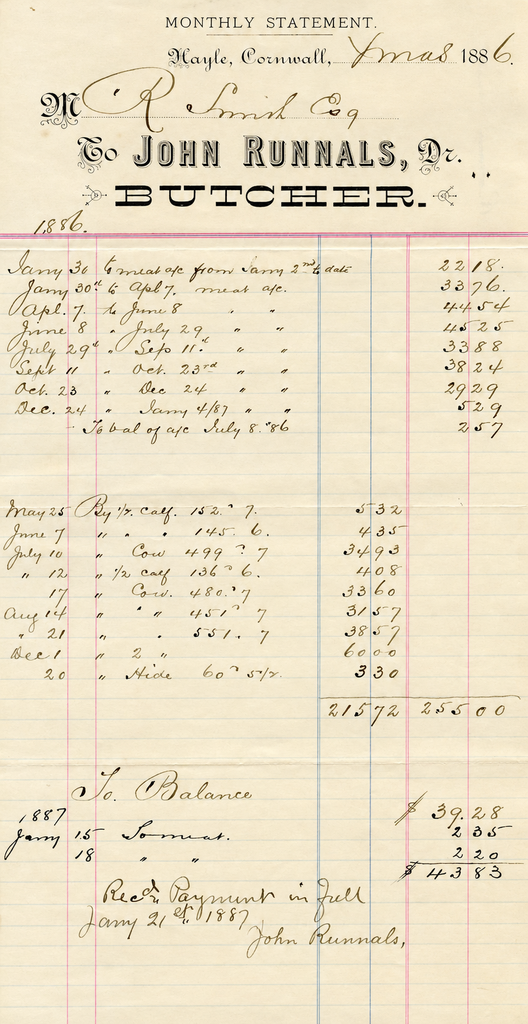
The statement you showed is headed Hayle, Cornwall, 1886 and is made out to John Runnals.
That makes the document potentially very interesting historically.
If the original document really is from 1886, it would place Runnals in the Hayle meat trade about seven years before the purpose-built Penpol Terrace shop of 1893.
In other words, a plausible timeline is:
1886 — John Runnals already operating/being supplied as a butcher in Hayle
↓
1893 — purpose-built John Runnals butcher’s shop constructed at 42 Penpol Terrace
↓
1909 — the shopfront was redesigned/altered by Sampson Hill according to Hayle’s townscape documentation.
That makes your statement potentially valuable evidence of the earlier phase of Runnals’ business, before his better-known Penpol Terrace premises.
What the statement itself tells us
The document is also quite revealing about how the trade worked.
It appears to be a monthly account between a butcher and a customer, with repeated entries for meat supplied over many months. The account records things such as calves, cows and hides, rather than simply being a modern-style retail receipt.
That suggests we’re looking at a business operating within a broader livestock/meat supply system, rather than merely someone selling packaged meat over a counter.
The presence of amounts for things such as calf, cow and hide is particularly interesting. A Victorian butcher could potentially make money from several parts of the animal, with hides having a commercial value in their own right.
Hayle’s wider setting
The census records also show just how industrial Hayle was at this time. The same 1891 records contain occupations such as shipyard labourers, iron workers, copper smiths, saddlers and other trades, alongside the butchers and food retailers.
So a Hayle butcher in the 1880s–90s was serving a town with a mixed population of:
- industrial workers
- shipyard workers
- mariners
- engineers and foundry workers
- tradesmen
- farmers and agricultural workers from the surrounding area
- established middle-class households
That helps explain why several butcher businesses could operate in a relatively small town.