
First Wesleyan Chapel
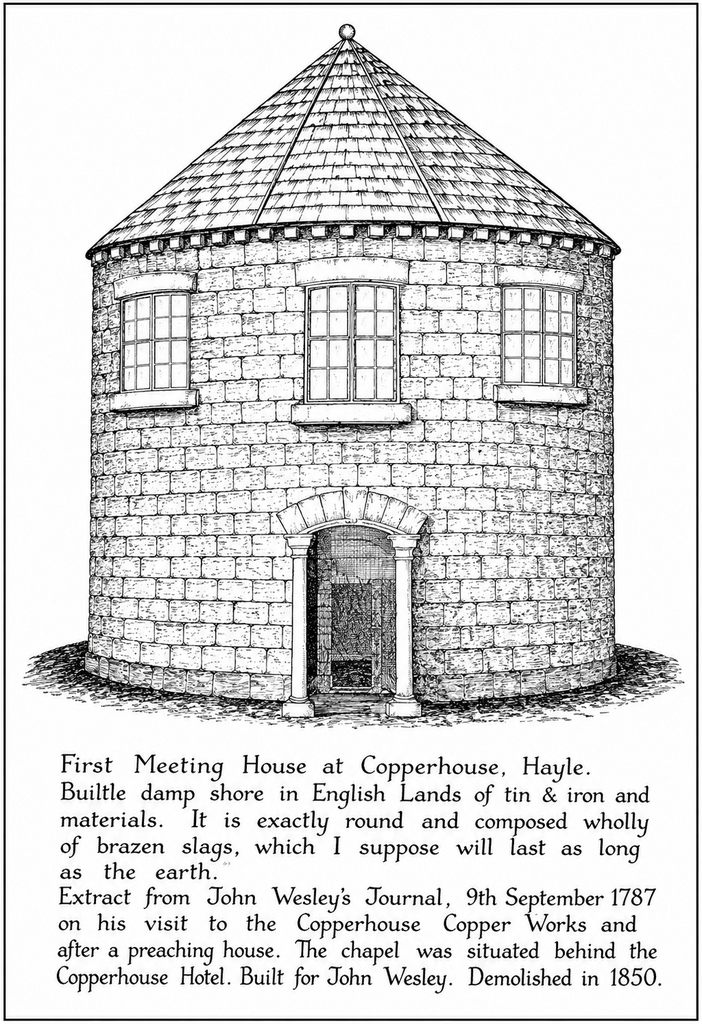
The first Wesleyan Chapel at Copperhouse was one of the most remarkable Methodist buildings ever constructed in Cornwall. Built in 1785, it was a small circular preaching house erected specifically for the visit of John Wesley. It stood near Copperhouse Dock, behind what later became the Commercial Hotel (now the Copperhouse Hotel).
Its most distinctive feature was its construction. Instead of stone, the walls were built almost entirely from scoria (copper slag)—the waste material produced by the Cornish Copper Company’s smelting works. The company’s leading figures were prominent Methodists, and the abundant supply of slag made it an inexpensive and highly durable building material.
John Wesley preached there for the first time in August 1785, delivering a sermon on John 5:19. He returned in 1787, and afterwards wrote one of the best-known descriptions of the chapel:
“Unlike any other in England… It is exactly round and composed wholly of brazen slags, which I suppose will last as long as the earth.”
The unusual building clearly made a lasting impression on him.
The chapel served the rapidly growing Methodist community in Copperhouse for around thirty years. As the town expanded with the success of the copper industry, the congregation soon outgrew the little round building. In 1816 (some sources give 1817 for completion), a much larger Wesleyan chapel was built further up the hill in Chapel Lane, designed on the model of the Great Wesley Chapel in London. Rather than waste the old materials, many of the scoria blocks from the original round chapel were reused in the new building. Although both the original Round Chapel and its 19th-century replacement have since been demolished, the story of the first chapel remains an important part of Hayle’s heritage. It symbolises the close relationship between Methodism and the Cornish copper industry, where industrial by-products became the fabric of a place of worship. The chapel was also one of the earliest permanent Methodist preaching houses in west Cornwall and helped establish Copperhouse as a centre of Wesleyan activity for generations.