
Going Nineteen to the Dozen
The origin of the phrase “going nineteen to the dozen” is claimed by many to date back to the Cornish tin and copper mines, which regularly flooded, particularly as they went deeper in search of minerals. Advances in steam technology meant that the hand pumps and horse whims used to pump out the water were gradually replaced by beam engines, which could pump 1,900 gallons of water for every 12 bushels of coal burned (1 bushel = 8 imperial gallons or 84 pounds).
Thomas Newcomen’s atmospheric engine (1712) was used in many Cornish mines and elsewhere, but it was relatively inefficient and consumed large amounts of fuel. D. B. Barton notes the following: “Whilst there may have been some slight improvement in the Newcomen engine by the 1770s, its capacity for ‘eating steam’ was but little impaired. The consumption of the two Eastern engines (60” and 66”) at Poldice under the trial in August and September 1778 was 14,080 bushels of coal. This cost about 42s per wey of 64 bushels, giving a consumption of about 2,000 tons of coal per engine each year, at a cost of about £1,400.”
The price of a ton of coal had reached £1 per ton by 1821, equivalent to approximately £100 today.
Improvements were gradually made by a number of engineers until James Watt realised that the heat needed to warm the cylinder could be saved by adding a separate condensing cylinder. This, along with other changes, produced a more reliable design which used half as much coal to produce the same amount of power. In 1775, Watt entered into partnership with Matthew Boulton, and they began installing their patented steam engines in Cornwall, with strict licensing arrangements governing their use.
The coal used in Cornwall had to be imported by ship, mostly from Wales, to keep the engines running. Getting coal to the engines was, in itself, a difficult and expensive operation. Thus, any improvement in the ratio of coal burned to water raised was to be welcomed.
Smelting also required large amounts of coal: smelting one ton of copper required three tons of coal. Thus, ports such as Portreath, perhaps the busiest and most important mining port in Cornwall, played a significant role, exporting copper ore to South Wales and importing Welsh coal and timber for the mines.
It is no surprise, then, that many colliers were wrecked around Cornwall during rough weather. A more recent example is the steam collier Bessie, which ran aground at Carbis Bay on 19 November 1893, along with two other vessels, Cintra and Vulture, during a violent storm after seeking shelter in the bay.
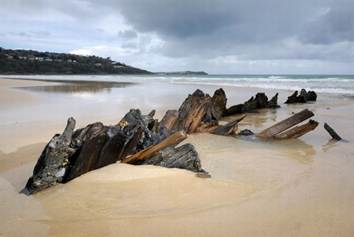
The jagged remains of Bessie were revealed in 2024 following another winter storm. Further along the beach, on days when the spring tides dropped to their lowest levels, the wreck of Cintra could also be seen up close.
Then along came Richard Trevithick, who continued to improve the efficiency of the Cornish engine by introducing high-pressure steam to a Watt engine. A number of experiments were conducted at various mines, notably at Binner Downs, Leedstown, where Trevithick noted in 1828 that two engines installed there “formerly … worked without cylinder cases, when the 70-inch cylinder burnt 1.5 wey of coal, and performed a regular duty of forty-one millions; since that time brickwork has been placed round the cylinder and steam-pipes, leaving a narrow flue, which is heated by separate fires. These flues consume about 5 bushels of coal in twenty-four hours: the heat is not so great as to injure the packing, which stands good for thirteen weeks; the saving for several months past has increased the duty to sixty-three millions”.
These and other trials prompted Trevithick’s friend Gilbert Davis to write that “one bushel of coal, weighing 84 lbs., has been found to perform a duty of thirty, forty, and even fifty millions, augmenting with improvements, chiefly in the fire-place, which produce a more rapid combustion with consequently increased temperature, and a more complete absorption of the generated heat; in addition to expansive working, and to the use of steam, raised considerably above atmospheric pressure”.
Further technical details of Trevithick’s experiments at Binner Downs can be found in Life of Richard Trevithick: Vol. 2, Chapter 26 (1872), written by his son Francis.
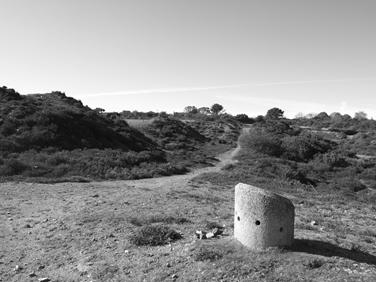
General view of Binner Downs, 2008, showing capped mineshaft and heathland. (Photo: Mark Spalding-Jenkin).
No structures remain on the surface at Binner Downs today; its most distinctive features are the dumps (burras) covering the entire site. Numerous mine shafts honeycomb the ground below. The mine reached a depth of 185 fathoms (338 metres) and, in 1838, the year it closed, had six steam engines and 390 employees.
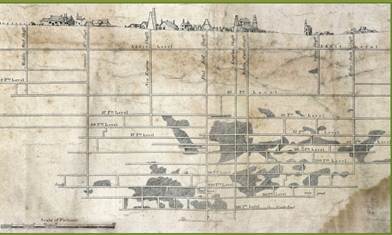
A mine section plan from the early nineteenth century, reproduced on an information board at the site, shows various buildings on the surface, including the Count House, horse whims and numerous steam beam engines.
The site is now covered in vegetation, predominantly gorse and ling, growing on the reworked and contaminated land. Binner Downs was one of 12 abandoned Cornish mine sites surveyed by A. Spalding and others in 1994 and 1995 for their insect interest, with 103 species being recorded.
In conclusion, I like to think that the experiments carried out by Richard Trevithick at Binner Downs may have contributed in some way to the evolution of the phrase “going nineteen to the dozen”. Or perhaps it simply refers to anybody who talks too fast or anything that is going too fast.
Another explanation is that the Victorian sewerage system built in London was powered by a very large steam-driven beam engine which, at full power, could pump raw sewage into the river as the tide was going out at a rate of 19 tons of sewage for every 12 strokes of the beams.
Tony Clifford
January 2025