
Hayle Railway
The Hayle Railway in the Early Days
The Hayle Railway was one of Cornwall’s pioneering railways and played a crucial role in transforming Hayle into one of Britain’s most important industrial ports. Opened in 1837, it was built primarily to carry copper ore, tin ore, coal and machinery between the mines of Camborne and Redruth and the harbour at Hayle.
Why was it built?
By the early 1830s, thousands of tons of ore and coal were still being hauled by horse and cart over rough roads. The success of the nearby Redruth & Chasewater Railway inspired local mine owners and industrialists to build a railway linking Hayle’s harbour with the rich mining districts inland.
Parliament approved the Hayle Railway in 1834, and after three years of construction the first section opened on 23 December 1837.
The original route
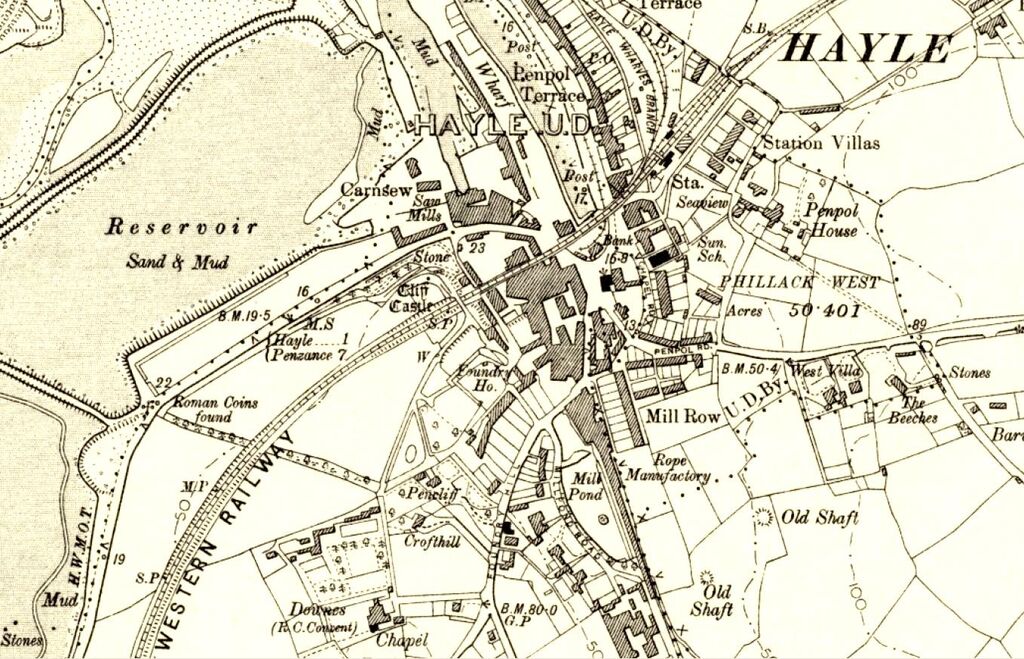
The railway ran from Foundry Square in Hayle to Redruth, with branches serving:
- Portreath Harbour
- Tresavean Mine
- South Crofty Mine
- North Roskear Mine
At Hayle, the terminus was beneath the site of today’s railway viaduct, close to Harvey’s Foundry, allowing goods to move directly between ships, workshops and railway wagons.
Steam engines… and ropes!
Although the Hayle Railway was among the first Cornish railways to use steam locomotives, the landscape between Hayle and Camborne presented a major challenge.
The steep hills were too much for the locomotives of the day, so two sections were worked by stationary steam engines using thick ropes to haul wagons up and lower them down the inclines.
The most famous was the Angarrack Incline, which was around 1,900 feet (580 metres) long and climbed approximately 185 feet (56 metres). Powerful winding engines at the top hauled trains up the slope while controlling descending wagons.
Crossing Hayle
One of the railway’s most unusual features was the way it threaded through the town. The line:
- Crossed Copperhouse Creek on a swing bridge.
- Ran beside today’s King George V Memorial Walk.
- Passed along North Quay.
- Ended at Foundry Square beside Harvey’s engineering works.
This close integration with the harbour made loading ships fast and efficient.
The arrival of passengers
Although built for freight, the railway soon began carrying passengers.
Regular passenger services between Hayle and Redruth started in 1843, initially using simple facilities before a proper station building opened in Foundry Square in 1844. Travelling between the mining towns became much quicker than by horse and carriage.
Brunel changes everything
By the late 1840s the old railway’s steep inclines and winding route had become a bottleneck.
The newly formed West Cornwall Railway, under the direction of Isambard Kingdom Brunel, built a new line on a gentler alignment. It opened in 1852, crossing Hayle on a spectacular timber viaduct (later rebuilt in brick in 1886), while bypassing the original rope-worked inclines. Much of today’s railway follows Brunel’s route rather than the original Hayle Railway.
What can still be seen today?
Although much of the original railway has disappeared, several reminders survive:
- Parts of the former railway embankments.
- The historic bridge over Copperhouse Creek.
- Sections of the old quayside railway.
- The route of the Angarrack Incline.
- The site of the original Foundry Square station beneath today’s viaduct.
Did you know?
The Hayle Railway was one of the first standard-gauge steam railways in Cornwall, opening in 1837, and it helped establish Hayle as one of the county’s most important engineering and shipping centres. Without it, Harvey’s Foundry and the harbour could never have handled the enormous quantities of machinery, coal and ore that passed through the town during Cornwall’s mining boom.