
Rudolph Erich Raspe
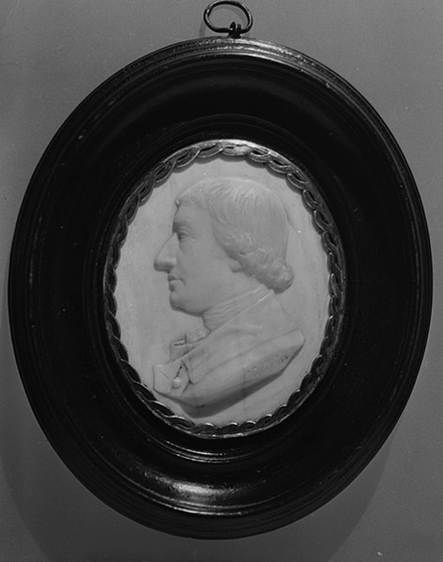
Glass paste medallion of Rudolph Erich Raspe (1735–1799) by James Tassie, 1784. (Metropolitan Museum of Art)
After studying natural sciences and languages at Göttingen and Leipzig, Rudolph Erich Raspe (RER) worked in various university libraries before being appointed librarian and custodian of the Landgraf’s collection of gems and coins at Kassel in 1767. However, in 1775, he was charged with stealing from the Landgraf’s gem collection and had to flee, first to the Netherlands and then to England, to escape arrest.
RER resided in London for some years, working on translations from German and publishing original scientific books. As usual, his lifestyle exceeded his ability to earn money and, by 1780, he appears to have been very poor, eventually ending up in the Fleet debtors’ prison. His liberty was secured by a donation from Horace Walpole.
Despite all the above, RER managed to acquire a scholarly reputation. He wrote and published extensively on a wide range of subjects and was also a chemist and geologist, with a particular interest in tungsten.
From 1782, RER was employed by Matthew Boulton as assay-master and storekeeper at Dolcoath Mine in Cornwall. The local headquarters of Boulton and Watt was at Cusgarne House, near Chacewater Mine. In 1786, the Boulton and Watt assay office in Cornwall was closed, and some accounts say that Raspe returned to London.
Robert Hunt writes in 1885: “[RER’s] chemical and mineralogical knowledge appears to have recommended him to the adventurers in Dolcoath copper mine, near Camborne, in Cornwall. We find him, about 1782 and the following years, residing at the bottom of the hill in Redruth town, near where the Druids’ Hall now stands. Raspe was at first elected as Store-master at the mine, but his scientific knowledge speedily recommended him as chief copper smelter to the company”.
The entrance to the shell of the former Druids Hall leads today from Penryn Street to St Rumon’s Gardens, which were opened in 2000 on the site. The gardens occupy the location of what was formerly Redruth’s cultural centre, destroyed by fire in 1984.
Hunt concludes: “There can be no doubt but that Rudolph Eric Raspe was a well-educated German, possessing a knowledge of minerals and metallurgy unusual at that time amongst our British miners, but a very ill-regulated character. He does not appear, however, to have been successful in his metallurgical experiments in Cornwall, and there was a certain degree of lax morality following him through life which rendered him untrustworthy. An analogous character to the amusing Baron, of whose travels he wrote so well, would not be likely to inspire his employers with confidence; consequently, we find Raspe struggling with poverty whilst residing at Redruth, and during the time when he was endeavouring to make for himself a name amongst the scientific men of London”.
In October 1783, a German periodical essay, thought to have been written by RER, provided eyewitness accounts of the Cornish mining industry and its steam engines.
In 2003, a 150-year-old lump of tungsten was found at Trewhiddle Farm, near St Austell, leading to speculation that it may have been produced during a visit by RER to Happy Union Mine at nearby Pentewan in the late eighteenth century. If so, this may predate the earliest known smelting of the metal, which requires extremely high temperatures.
While in Cornwall, RER seems to have written the original version of The Surprising Adventures of Baron Munchausen, originally a satirical work with political aims, published anonymously in 1785. Raspe’s Munchausen became a sensation, “establishing a literary exemplar of a bombastic liar or exaggerator”.
RER based his fictional character on an old acquaintance, the real-life Karl Friedrich Hieronymus, Freiherr von Münchhausen (1720–1797), a Hanoverian storyteller famous as a raconteur of extraordinary tales about his life as a soldier, hunter and sportsman.
The tales were further embellished and translated back into German by Gottfried August Bürger in 1786. They were frequently extended and translated throughout the nineteenth century, with further fictionalisation in the 1901 American novel Mr Munchausen.
In 1951, Richard Asher coined the term “Munchausen syndrome” to describe a pattern of self-harm, “wherein individuals fabricated histories, signs, and symptoms of illness”. “Munchausen syndrome by proxy” is a term used to describe a carer, most often a mother, who either invents symptoms or deliberately causes real symptoms to make it appear that a child is ill.
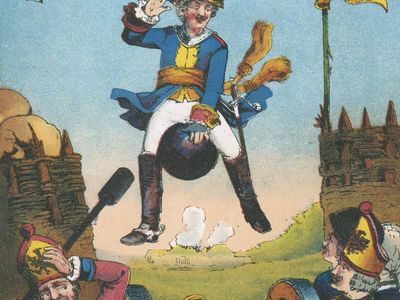
The baron surprising artillerymen by arriving mounted on a cannonball. Illustration from a nineteenth-century edition of The Adventures of Baron Munchausen by Rudolf Erich Raspe.
In 1789, Raspe left Dolcoath Mine and spent the summer and winter in Scotland searching for minerals. He is said to have discovered copper, lead, iron, cobalt and manganese on Sir John Sinclair’s estate at Ulbster, Caithness, leading “the sanguine proprietor to hope for some rich reward”.
He began a geological survey of Caithness but appears to have been deceived by the introduction of “mundic” iron pyrites, brought from Cornwall and passed off as rich copper ore. The discovery of the fraud brought the exploration to an end.
RER fled to Ireland in 1791, where he later died of a fever in Muckross, County Kerry.
Tony Clifford
March 2025.