
Stick insects in West Cornwall
By Tony Clifford
In July 2017, I was clearing a patch of brambles and various climbing plants, such as ivy, clematis and honeysuckle, growing on a pergola when a stick insect appeared on the newly revealed wall. Unfortunately, I didn’t take a photograph – I was too busy working!
I notified the local representative of the Phasmid Study Group, and what follows is an edited version of his succinct reply.
My notification was the fourth from Leedstown, with the very first sighting, in 2010, recorded immediately opposite mine, alongside the chapel. Another earlier report concerned a sighting on Horsedowns Road, about 100 yards east of me. These were all identified as the Unarmed stick insect (Acanthoxyla inermis), certainly the same species as mine.
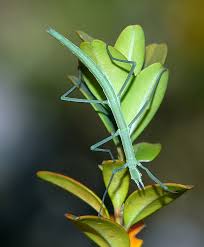
The Unarmed stick insect has also been confirmed at nearby Reawla, Townshend and Praze-an-Beeble, as well as slightly further afield in Goldsithney, Perran Downs and Hayle. These stick insects have neither the need nor the ability to travel far under their own steam, so all colonies are highly localised to a few nearby gardens.
Their main means of distribution is with human help, as we bring plants into our gardens from areas where stick insects are present. There are now several garden centres in Cornwall which have this species within their grounds, and as we buy their plants, the stick insects occasionally come too.
I wrote about the Kowhai plant from New Zealand in my garden in SW Bulletin No. 44 (5 March 2021), which was probably the mode of transport used by my stick insect.
The Unarmed stick insect originates from New Zealand and has been known in Cornwall since at least the 1920s, arriving on imported timber and plants. One example was at Treseder’s Nursery, Truro, in 1979.
It is one of three species of stick insects that now live in the south-west of England. They can be either brown or green, with green being the more common. All those normally seen are female, laying fertile eggs without the need for a male – a process known as parthenogenesis. Because they can maintain populations in this way, males of the species are functionally redundant. This gives the stick insect the ability to establish breeding populations from just one female individual.
They have an annual life cycle, hatching from eggs in spring and growing quickly to become adults by summer. Adults have a body length of about 10 cm (4 inches), or 15 cm (6 inches) when you include the front and rear legs, making them the longest insects in the UK.
Adults do not live very long, with few surviving much into winter. During their brief adult lives, they can lay several hundred eggs, which simply drop below the bush on which the insect was feeding, ready to start the life cycle again the following spring. A very small number might overwinter in sheltered areas, but this is not important for the survival of the species. It is the eggs laid in summer and autumn that carry them through from one year to the next.
Privet and bramble are very much the stick insect’s favoured food plants, although they have been found on many different types of plants, including conifers such as Leylandii hedging.
At this time of year (July), most stick insects are juveniles, having emerged over the previous six weeks from eggs laid the previous summer and autumn. When they hatch, their instinct is to walk about and climb up the first thing they see, which is likely to be the plant on which the parent fed the previous year.
Once they get onto the plants, they are not often seen, as they typically clamp themselves tightly against plant stems during the day to avoid being noticed by predators. As darkness approaches, they begin to move about and feed.
If you find one, there may be more in your garden. If you want to check, a torchlight search around dusk, starting near where you found the original, may reveal several feeding on a plant.
Stick insects do not need to wander about much, as they are surrounded by food and have no need to find a mate. Once you have located the main area where they are feeding, this stationary lifestyle means you can regularly check the area around dusk and watch them grow. Most will be adults by the end of July.
Stick insects will cause you no harm, but they can give you a nasty prod!
So, what’s green and sticky? A stick insect!
Tony Clifford
April 2024